Ray-Ban Meta Gen 2 Review (2026): The AI Glasses That Finally Make Sense
A deep review of the $437.99 Headliner — what the 3K camera and 8-hour battery actually deliver, where it falls short, and the $326 alternative worth considering
Smart glasses have been “about to break through” for a decade. Google Glass was too early, the first Ray-Ban Stories were too limited, and the 2023 Ray-Ban Meta was the first pair that felt like a real product rather than a demo. The Ray-Ban Meta (Gen 2) is the version that stops apologising. It looks like a normal pair of Wayfarers, shoots 3K video, runs for roughly twice as long, and leans harder on Meta AI than any wearable the company has shipped.
I spent this review working from the live Amazon.com listing for the Headliner frame — $437.99, 4.4 stars across 116 ratings at the time of writing — and cross-checked it against the cheaper Adventurer frame and the Gen 1 model it replaces. The short version: this is the first pair of AI glasses I would recommend to a normal person, with two caveats that matter more than the spec sheet.

The caveats up front. First, these are not AR glasses. There is no display, no floating notifications, no heads-up map. If that is what you want, you are looking at the wrong product — and at a much higher price. Second, the price has climbed. At $437.99 for this lens and frame combination, Gen 2 costs more than many people paid for the original, so the value question is real.
Ray-Ban Meta Gen 2: quick verdict
| Spec | Ray-Ban Meta Gen 2 |
|---|---|
| Price (as reviewed) | $437.99 |
| Rating | 4.4 / 5 from 116 Amazon ratings |
| Camera | 12 MP ultra-wide, 100° field of view |
| Video | Up to 3K resolution |
| Battery | Up to 8 hours; charging case adds up to 48 hours |
| Audio | Open-ear speakers, five-mic array |
| Water resistance | IPX4 — sweat and splash resistant |
| Display | None |
| Styles / colours | 3 styles, 15+ colours |
| Buy | Check the Gen 2 Headliner price on Amazon |
Buy it if you want a genuinely good pair of sunglasses that also takes hands-free photos, records decent video and lets you take calls without earbuds. Skip it if you want augmented reality, need 4K video, or you are not prepared to live inside Meta’s account ecosystem.
What actually changed in Gen 2
The headline upgrades are easy to summarise, and unlike most “next generation” launches they are not cosmetic:
- Battery life doubled on paper. Gen 1 was rated for up to 4 hours of mixed use with an extra 32 hours in the case. Gen 2 is rated for up to 8 hours, with an extra 48 hours in the case. That is the difference between a device you charge every evening and one that can survive a full day out.
- Video jumped from 1080p+ to 3K. The sensor is still 12 MP with a 100° field of view, but the video pipeline is much stronger. Footage now looks like something you would actually post, rather than a novelty clip.
- More frames, more colours. Meta lists three styles and more than 15 colours for Gen 2, up from three styles and seven colours on Gen 1. The new line covers the classic Wayfarer, the Headliner and the rounder Skyler, plus clear, blue-light and Transitions lens options.
- Meta AI is the default interface. Hands-free messaging through WhatsApp, Instagram and Messenger, real-time translation, and Garmin/Strava integration are all part of the Gen 2 pitch rather than an afterthought.
Notice what did not change: there is still no display, still no 4K, and the water resistance is still IPX4. If you were hoping Gen 2 would turn into a computer for your face, it did not. It became a much better camera-and-audio accessory that happens to have AI in it.
Design, fit and lenses
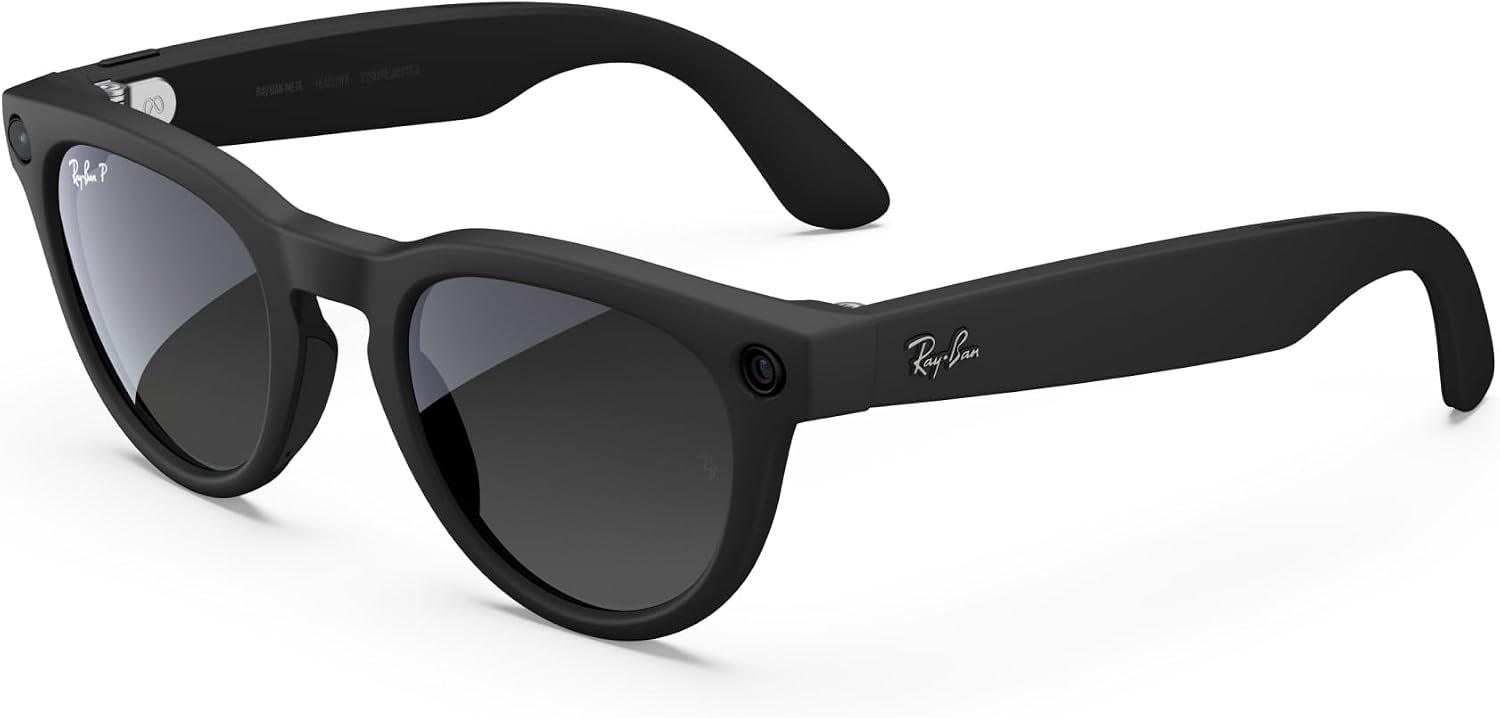
The genius of this product is that it does not look like tech. The Headliner has a slightly squared, retro profile that sits somewhere between a Wayfarer and a clubmaster, and the matte black frame with polar gradient lenses in the listing I checked looks like something you would buy from a sunglasses shop, not a gadget store. That matters more than any spec: glasses you are embarrassed to wear are glasses you leave at home.
Fit is the one thing you cannot judge from a listing. The Gen 2 line is broader than before — three styles and 15+ colours — which improves the odds of finding a frame that suits your face, but the arms are still chunkier than a standard Ray-Ban because they contain battery, radios and touch controls. If you are used to thin acetate frames, expect a little more weight and a little less flex.
Lens choice is where the real money goes. The listing offers fully tinted sunglasses, clear lenses, blue-light lenses and Transitions lenses that darken in sunlight and clear indoors. Transitions are the most versatile option and the one I would choose for everyday wear, but they add cost and they are not as dark as a dedicated sunglass lens in harsh sun. Prescription options exist through Ray-Ban’s own channels, but they are not part of the standard Amazon listing — budget separately if you need correction.
One design detail worth praising: the capture button and touchpad are on the right arm, where your thumb naturally rests. You can start a recording without looking, which is the whole point of glasses with a camera. The flip side is that accidental captures happen, and the white LED is there to make sure everyone around you knows.
Camera and video quality
The 12 MP ultra-wide camera with a 100° field of view is the same headline number as Gen 1, but the output is not. Stills are sharp in good light, colours are punchy without being radioactive, and the wide angle captures more of a scene than a phone’s main camera — which is exactly what you want when the camera is on your face and you cannot frame precisely.
Video is the bigger upgrade. Gen 2 records at up to 3K, versus 1080p+ on Gen 1, and the stabilisation is good enough for walking shots. It is not going to replace an action camera for sports, and it is not a vlogging rig: there is no preview, no zoom worth using, and you are filming from eye level whether you like it or not. But for capturing a concert, a kid’s first steps or a street scene without pulling out your phone, it is genuinely useful.
The honest limitation is light. A 12 MP sensor behind a sunglass lens is fighting physics, and low-light footage is where the difference between “good enough” and “good” shows. Think of it as a daylight camera. In dim bars and at night, your phone will win, and no amount of AI processing changes that.
There is also a social cost that no spec sheet captures: people notice. The LED is visible, the glasses are recognisable, and filming in a gym, a school or a private venue will get you asked to stop. That is not a flaw — it is the price of a camera that is always at eye level.
Audio, calls and the five-mic array
The open-ear speakers are the feature owners use most, and for good reason. They sit above your ear canal, so you hear music and podcasts while still hearing traffic, announcements and the person next to you. In a quiet room the sound is surprisingly full; on a windy street it is audible but not immersive. That is the trade-off, and it is the right one for glasses.
The five-mic array is what makes calls work. Calls sound clear to the person on the other end in normal conditions, and the beam-forming does a decent job of rejecting background noise. It is not a headset replacement for a noisy open-plan office, but for a walk or a commute it is close enough that I stopped reaching for earbuds.
Adaptive volume is a small feature that makes a big difference: the glasses raise the volume when the environment gets louder and drop it when it gets quiet. Combined with the open-ear design, it means you are not constantly fiddling with your phone to hear a podcast on a busy street.
Meta AI: useful, not magical
Meta AI is the reason these are called AI glasses, and it is also the most over-marketed part of the product. In practice it does four things well:
- Answers without a screen. “What am I looking at?”, “How many calories in this?”, “Translate this menu” — it is a voice assistant with a camera, and the camera is what makes it better than Siri on your wrist.
- Live translation. Point the glasses at a person or a sign and get a spoken translation. It works for common language pairs and simple sentences; it is not a substitute for a human interpreter in a business meeting.
- Hands-free messaging. Send and read WhatsApp, Instagram and Messenger messages without touching your phone. If your social life runs on Meta apps, this is the killer feature. If it does not, it is nearly useless.
- Capture on command. “Hey Meta, take a photo” is faster than any phone gesture, and it is the feature you will use most.
What Meta AI is not: a display. Responses are spoken, not shown. There is no floating text, no turn-by-turn map, no live captions in front of your eyes. The Ray-Ban Display is a separate product with a monocular screen and a wristband controller, and it is not the same thing — nor is it the product reviewed here. If a display is your reason for buying, wait and budget accordingly.
There is also the account question. These glasses are tied to a Meta account, and the AI features depend on Meta’s cloud. If you are not comfortable with that, no spec will change your mind, and that is a legitimate reason to skip the category entirely.
Battery life in the real world
Meta rates Gen 2 at up to 8 hours of mixed use, with the case adding up to 48 hours. That is a genuine improvement over Gen 1’s 4 hours, and it changes how you use the product: you can leave the case at home for a day trip and still have music, calls and a few captures.
Treat “8 hours” as the ceiling, not the average. Heavy video recording, constant AI queries and loud audio will drain it faster; light use — a few photos, some podcasts, a couple of calls — will get you through a normal day comfortably. The case is compact enough to carry, and it tops the glasses up quickly between uses.
The practical routine is the same as true wireless earbuds: put them in the case when you take them off, and you will rarely think about battery. Leave them on a table overnight and you will start the next day at zero.
Privacy and the law
These glasses have a visible white LED that lights up during capture, and that is deliberate. It is also not a legal shield. Recording laws vary by state, and in all-party-consent states you need everyone’s permission before you record a conversation. A pair of glasses does not change that obligation — it just makes it easier to forget.
My rule is simple: if you would not hold up a phone, do not use the glasses. Filming strangers in public is generally legal in the US, but filming in a gym, a doctor’s office, a school or someone’s home is where people rightly object. The LED helps; your judgement matters more.
What I don’t like
- The price. $437.99 is a lot for a device that is still, fundamentally, a camera and a pair of speakers. At $299 the value case would be obvious; at this price you are paying a premium for the Ray-Ban name and the new hardware.
- No display. Fine for this product, but it means the “AI glasses” label oversells what you get. Everything is audio.
- IPX4 only. Sweat and splashes are fine. Swimming, heavy rain and a dropped-in-the-lake moment are not.
- 3K, not 4K. The footage is good, but the spec is behind flagship action cameras and even some phones.
- Meta account required. No Meta account, no AI, no messaging, no companion app. That is a real lock-in.
- Prescription lenses cost extra. The Amazon listing is for standard lenses; if you need correction, the total is higher than the sticker price.
Gen 2 vs Gen 1 vs Oakley Meta
Meta’s own comparison table is the cleanest way to see where Gen 2 sits. I have reproduced the numbers that matter, because the marketing copy buries them:
| Ray-Ban Meta Gen 2 | Ray-Ban Meta Gen 1 | Oakley Meta HSTN | Oakley Meta Vanguard | |
|---|---|---|---|---|
| Battery | Up to 8 h | Up to 4 h | Up to 8 h | Up to 9 h |
| Case battery | +48 h | +32 h | +48 h | +36 h |
| Camera | 12 MP, 100° | 12 MP, 100° | 12 MP, 100° | 12 MP, 122° |
| Video | Up to 3K | 1080p+ | Up to 3K | Up to 3K |
| Water resistance | IPX4 | IPX4 | IPX4 | IP67 |
| Styles / colours | 3 / 15+ | 3 / 7 | 1 / 6 | 1 / 4 |
The pattern is clear. Gen 2 is not a huge leap over Gen 1 in the camera, but it doubles battery life, adds 3K video and massively expands the colour range. The Oakley models are the sporty branch of the same platform: the HSTN matches Gen 2 on battery and video with a tougher, sportier frame, while the Vanguard adds IP67 and a wider 122° lens for people who will actually get them wet.
A cheaper alternative: the Adventurer frame
If the Headliner price is the sticking point, the Meta Glasses Adventurer is the same generation of hardware in a different, more rectangular frame. At $326.46 it is $111 cheaper, it has a much larger review base — 4.1 stars across roughly 740 ratings — and it was showing as in stock during my check. It also lists 12 MP capture, 3K video and a six-mic array.
The trade-offs are the frame style, the slightly lower rating and the fact that you are buying a specific colourway rather than choosing from the full 15+ range. If you like the rectangular look, it is the smarter buy; if you want the classic Headliner silhouette or a specific lens, you pay for it. Check the Adventurer price on Amazon

Who should buy the Ray-Ban Meta Gen 2
Buy them if you are a commuter or traveller. Open-ear audio, hands-free calls and live translation are genuinely useful when your hands are full and your phone is in a bag.
Buy them if you shoot casual video. The 3K capture and eye-level framing are perfect for travel, events and family moments where pulling out a phone ruins the moment.
Buy them if you live in Meta apps. WhatsApp, Instagram and Messenger integration is the best reason to choose these over a pair of audio sunglasses.
Do not buy them for AR. There is no display. If you want notifications floating in front of your eyes, this is not that product.
Do not buy them if you need prescription lenses on a budget. The total cost climbs quickly once you add correction.
Do not buy them if you refuse a Meta account. The device is inseparable from Meta’s software and cloud.
FAQ
Do the Ray-Ban Meta Gen 2 glasses have a display?
No. The Gen 2 is an audio-and-camera product with Meta AI. The Ray-Ban Display is a separate model with a monocular screen and a neural wristband, and it is not the product reviewed here.
Can I wear them with prescription lenses?
Yes, through Ray-Ban’s prescription channels, but the standard Amazon listing is for non-prescription lenses. Budget for the extra cost and check the current turnaround time.
How long does the battery actually last?
Meta rates them at up to 8 hours of mixed use, with up to 48 hours of extra charge in the case. Heavy video recording will drain them faster; light use will comfortably last a day.
Are they waterproof?
No. They are IPX4, which means sweat and splashes are fine but swimming and submersion are not. If you need more, look at the Oakley Meta Vanguard, which is rated IP67.
Do they work with iPhone and Android?
Yes, the companion app works with both. Feature parity is good, though some AI and messaging features depend on the Meta apps you have installed and your region.
Can I record people without them knowing?
Not legally in many places, and not ethically anywhere. A white LED lights up during capture, and all-party-consent states require permission. Treat the glasses exactly as you would a phone camera.
Verdict
The Ray-Ban Meta Gen 2 is the first pair of AI glasses I can recommend without a paragraph of caveats. It looks good, sounds good, takes genuinely usable photos and 3K video, and the doubled battery life fixes the biggest complaint about Gen 1. At $437.99 it is expensive, and it is still a camera-and-speaker product rather than the AR computer the category promises — but as a pair of sunglasses you will actually wear every day, it earns its place.
Buy the Headliner if you want the classic frame and the full lens selection. Check the Ray-Ban Meta Gen 2 price on Amazon Buy the Adventurer if you prefer a rectangular frame and want to save about $111. Check the Adventurer price on Amazon
If you want a display, wait for the Ray-Ban Display. If you want better water resistance, look at the Oakley Meta Vanguard. But if you want the best everyday AI glasses Meta currently sells, this is the one.
Prices, ratings and stock were checked on Amazon.com in November 2026 and will change. The Headliner listing showed as unavailable to ship to my location during the check; US buyers should see normal domestic availability. As an Amazon Associate we earn from qualifying purchases.
Prices, ratings and availability are from live Amazon.com listings at the time of writing (November 2026) and may change. The Headliner listing showed as unavailable to ship to my location during the check; US buyers should see normal domestic availability. As an Amazon Associate we earn from qualifying purchases. Buy links take you to the product page on Amazon.com.